




Refined vs Unrefined Sunflower Oil: Which Is Better for Food Businesses?
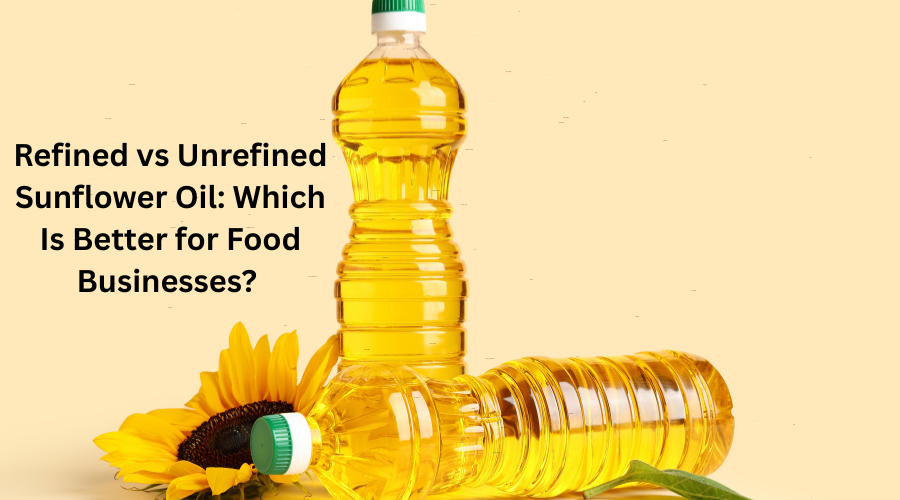
A common mistake that numerous food businesses make when sourcing for sunflower oil for their products is that they choose sunflower oil based on the word “refined” or “unrefined” instead of asking whether the oil actually fits their production process.
That kind of negligent decision-making can backfire. Choose the wrong oil, and you will get unwanted flavor, and quality issues that could have been avoided. At scale, a seemingly small mismatch can quickly become a procurement problem.
The refined vs unrefined sunflower oil decision is more about matching the oil to your food production scenario rather than a head-to-head comparison on superiority of one variant. The winner depends on your manufacturing setup and type of food product you want.
However, generally speaking, refined sunflower oil has a more neutral profile, and greater consistency. In contrast, unrefined oil retains more of its natural character, which can be valuable for specialty or premium products where flavor, color, and organic branding matter.
The smarter approach is to stop choosing the oil that sounds better and start choosing the oil that performs better for your business.
Refined vs Unrefined Sunflower Oil: What Is the Difference?
The biggest difference comes down to processing.
Refined sunflower oil goes through several stages of processing that are designed to remove unwanted components. Depending on the refining method, these can include degumming, neutralization, bleaching, dewaxing or winterization, and deodorization. The objective is to produce an oil with a cleaner appearance and a milder odor.
Unrefined sunflower oil undergoes considerably less processing. The final result is an oil that retains more of the characteristics that come from the seed. This includes color, aroma, flavor, and certain minor compounds.
There is an important issue that procurement teams should keep in mind when sourcing unrefined sunflower oil. And that is that unrefined sunflower oil is a vague label and is not all unrefined oil is the same as industrial crude sunflower oil. Extraction method, filtration, treatment, and intended food use can vary significantly between unrefined sunflower oil products.
So, before comparing labels, compare specifications.
Refined Sunflower Oil Benefits for Food Businesses
For many food manufacturers, the strongest argument for refined sunflower oil is not better visible appearance but the
When you manufacture at scale, an oil that behaves consistently from one batch to another can save you from unnecessary formulation adjustments and production headaches.
Neutral flavor and aroma
Refined sunflower oil is generally valued for its relatively neutral sensory profile. This makes it useful when you want the ingredients that define your product to remain the focus.
For bakeries, snack manufacturers, sauces, processed foods, and other formulations, a pronounced oil flavor may not be desirable. A neutral oil gives your formulation more room to perform without introducing an obvious additional taste.
Cleaner appearance
Refining the oil removes pigments and other chemicals that give the oil a darker shade or more distinctive appearance of less processed oils.
That matters when appearance is part of your product specification. A lighter oil can be preferable for applications where you want the finished food to retain a clean, consistent visual profile.
More controlled specifications
Commercial production depends more on oil specifications rather than labels of being refined or unrefined. Sometimes refined oils lack qualities that make it suitable for processing.
For bulk procurement the practical lesson is more important than any single number: do not judge an oil only by whether it is refined. Review the actual specification and certificate of analysis supplied with each bulk lot.
Broad commercial versatility
Refined sunflower oil is a versatile product and serves a wide range of food applications because of its neutral odor and controlled physical properties.
If your business needs a multi-purpose oil for production of several mainstream products, refined oil may simplify purchasing and production planning.
That does not mean it is always the superior choice. It means its strengths align well with production operations where consistency and neutrality is of highest priority.
Unrefined Sunflower Oil Uses in Food Production
Unrefined sunflower oil has a different commercial value.
Instead of removing much of the oil's original character, minimal processing can preserve more of its natural color, aroma, and flavor. That can be an advantage when these characteristics make the finished foodstuff distinct from a competitor’s.
It becomes an excellent choice for
-if you want your dressings and sauces to have an authentic taste that is not influenced by the sunflower oil's natural flavor.
-specialty foods where a less processed ingredient profile supports organic product positioning.
-artisanal or premium products where distinctive flavor and color are desirable
-cold-use applications where the oil does not need to deliver the same neutral profile as a highly processed ingredient
-products positioned around traditional or minimally processed ingredients
One thing you should never forget is that “less processed” does not automatically mean “better for every application.”
If your product requires a neutral flavor, very light color, or specific processing characteristics, the qualities that make unrefined oil attractive can become limitations.
How the Two Oils Compare for Commercial Food Applications
|
Factor |
Refined Sunflower Oil |
Unrefined Sunflower Oil |
|
Flavor |
Generally neutral |
More characteristic |
|
Color |
Lighter and clearer |
More natural or pronounced |
|
Processing |
More extensively processed |
Minimally processed |
|
Consistency |
Often easier to standardize |
More dependent on source and process |
|
Product positioning |
Mainstream and high-volume |
Specialty and minimally processed |
|
Storage considerations |
Generally favorable when properly specified |
Requires closer attention to product specifications |
|
Best fit |
Baking, frying, processed foods, broad formulations |
Dressings, specialty foods, flavor-led applications |
A large snack manufacturer will naturally prioritize neutral flavor, and quality uniformity in processing. A specialty food producer may place greater value on natural flavor profile and minimal processing.
Both decisions are commercially sound.
Which Sunflower Oil Should Your Food Business Choose?
When deciding between the two, you should focus on the nature of your finished product, not the oil label.
Refined is better when
-A neutral sensory profile is useful, and you do not want the oil to compete with your product's flavor.
-Consistent appearance is important and when color variation could affect your finished product positioning or market appeal.
-Repeatable production is valuable and you require formulations and processes to behave consistently across large batches.
-Broad application flexibility is preferred for quality, particularly if the same procurement program supplies several product lines.
-Tightly controlled specifications are a requirement for maintaining a specific quality standard. In such situations, the limits for acidity, oxidation, moisture, and impurities in the finished product are clearly defined.
Unrefined is better when
-Distinctive flavor or aroma, is useful when the oil enhances the product quality.
-Natural color, matters for food products where a more unique visual appearance strengthens brand positioning.
-Minimally processed ingredients if the product is being marketed to health-conscious consumers who prefer organic.
-Specialty differentiation which is adequate when customers value ingredient character rather than complete neutrality.
What to Check Before Buying Sunflower Oil in Bulk
Once you move from comparison to procurement, the label is only the starting point.
Ask your supplier for a current specification sheet and certificate of analysis. Then evaluate the oil against the requirements of your production process.
Some oil specs that should be included in your assessment are:
Processing method and oil grade, so you know exactly what you are purchasing.
Free fatty acid level, which can help you assess the oil's condition and if it is compatible with your production process.
Peroxide value, as an indicator for oxidation status.
Moisture and impurities, particularly when the oil will enter a controlled industrial process.
Wax content, especially for sunflower oil where waxes can affect physical behavior and appearance.
Fatty-acid profile, when your product specification or labeling requirements depend on it.
Batch consistency, because an attractive first shipment means little if subsequent lots behave differently.
Storage and packaging conditions, since oil quality can deteriorate when handling and storage are poorly controlled.
Supplier traceability, particularly when you are buying at commercial volume.
This is where procurement discipline pays off.
There is no point in buying a cheaper sunflower oil variant if it creates formulation adjustments, quality complaints, and inefficient production.
Read our article to learn more about sunflower oil, its benefits, uses, types, and how to choose the right option for your needs: Sunflower Oil Buying Guide: How to Choose the Right Oil for Your Business.
Conclusion
The choice of refined or unrefined sunflower oil depends on the nature of your food business.If you want neutrality, uniformity, predictability of appearance and general commercial application then refined sunflower oil is normally the more practical choice. When natural flavor, color, minimal processing or specialty premium product positioning is truly a benefit to the product, unrefined sunflower oil can be a better match.
Don’t select based on the processing label alone. Answer is to select an oil according to your product, production process, quality requirements and brand positioning for target market. That decision logic will protect your product performance and your procurement budget.
Featured Articles
A common mistake that numerous food businesses make when sourcing for sunflower oil for their pro
READ FULLCommercial cooking is different from domestic and industrial types. The temperature range, freque
READ FULLSunflower oil is better than many alternatives when
READ FULLLeave Your Comments
Global Agri and Metal Tech Ltd(G.a.m.t Ltd)

Have a question or need a quote? Fill out this form and our team will get back to you quickly!