




Fresh Red Onion Quality Standards for Export
Maintaining quality is the utmost requirement of every exporter. If we talk about red onions, exporters have to be strict in quality because that is the utmost requirement. Any risk of mold, pests, excessive dust, or visible damage can cause problems for the exporter. On the global stage, quality has to be precise because the competition is tough. Any negligence can slowly take an exporter out of the competition. So, what are the quality standards that keep an exporter in the competition?
Standard vs Premium Grades
There are standard red onions, and there are premium red onions. The majority are standard onions because of their economical prices and larger supply. Both grades are free of visible and deep damage, but premium-grade red onions have strict quality inspection. They have the lowest rate of foreign particles or any visible damage.
When exporting wholesale fresh onions, exporters also have to work on the shape and size of onions. 25mm, 35mm, 45 mm, 55 mm, and 65 mm are the standard sizes of onions. However, premium types have the least inconsistency in the onion bulbs’ sizes. Standard bulbs might have some variations by a few millimeters, and this is why they are economical.
In standard red onions, slight shape variations are acceptable. Buyers who import onions also know about these variations in size. A few percentage points of size variations are acceptable in premium grade.
How Do Exporters Measure the Purity Level of Red Onion?
There are various physical and visual tests that help exporters meet global quality standards. They have to conduct these inspections when supplying wholesale fresh onions in different regions. The first thing they have to consider is physical impurities and flaws in onions. Dust, mold, and insects are the primary elements that help exporters separate the flawed onions.
They have to make sure there are no blackish marks on the onions, because they indicate signs of mold. Visible foreign particles like insects, dust, mold, and excessive moisture are signs of low-quality onions. During the onion import process, suppliers have to separate the clean and fresh ones for consistent quality.
What is the Acceptable Moisture Level of Red Onion for Exports?
In wholesale fresh onion exports, exporters have to work on the moisture level of onions. Usually, onions have a high moisture level, which is inside, not outside. If the moisture is outside, it is a sign of mold. Fresh red onions are dry and papery from the outside, and highly moist from inside. The usual moisture level of red onions is between 80% and 90%, but it is acceptable for onions whose shelf life is short. For longer shelf life, their moisture has to be reduced by 95%. So, exporters have to keep in mind that the acceptable moisture level of short-shelf-life onions is near 80%, and of long-shelf-life onions is 5%.
What are Visual and Smell Inspection in Red Onion Exports?
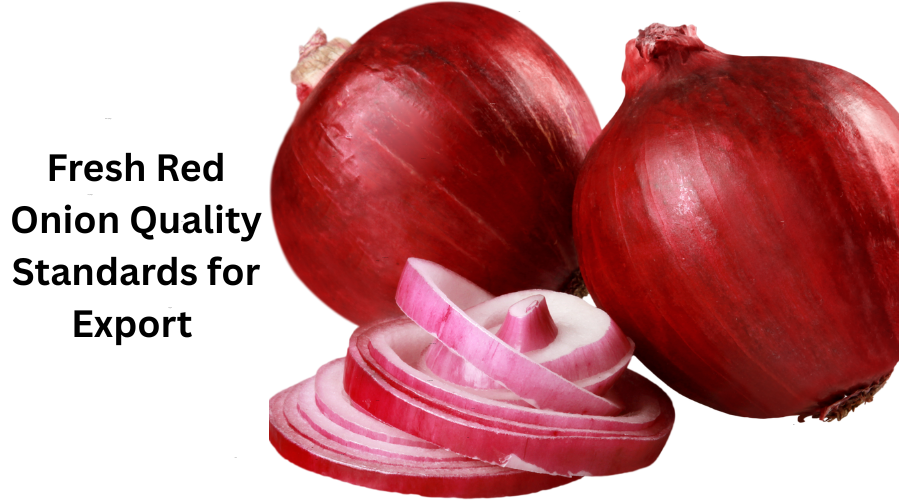
The visual test of wholesale fresh onion is about the outer skin, middle layer, and core. Outer skin must be dry, papery, and with an earthy smell. The inner layer and core must be glossy in appearance and have a pungent smell. Also, in the onion import process, buyers inspect them in the same way to test the quality. In terms of color, the core is white, the central layer is light purple, and the outer layer is brownish red.
Which Global Certifications Should a Fresh Onion Exporter Have?
Exporters have to comply with global standards to pass customs. When exporting wholesale fresh onions, they must have an import certificate along with all the following documents.
-Most exporters need a HACCP (Hazard Analysis Critical Control Point) document for permission.
-It includes a phytosanitary certificate, which ensures the safety of red onions from diseases and pests.
-Exporters from the UK and Europe need GLOBALG.A.P. (Global Good Agricultural Practice) to export red onions.
-Exporters who claim to export organic onions need Organic certification.
-If an exporter is from China, they need a GACC certificate (General Administration of Customs of China).
Likewise, each region and country requires exporters to have certifications to adhere to export rules.
Which Packaging Methods Keep Red Onions Fresh?
Even packaging methods have to comply with local and global rules. Choosing the wrong packaging material can risk quality compromise. No exporter wants to have mold or pests in their onion stocks. To prevent such risks, they use mesh bags to supply red onions. These backs provide high visibility, ventilation against moisture, and also prevent dust buildup. Some exporters use jute sacks, but they need dry storage. If there is any risk of moisture, it can trap the moisture inside to cause mold buildup. Premium red onions are often packed in cartons. These boxes are slightly costly, but they offer premium presentation. They also prevent impacts, dust, and moisture. Therefore, premium onions are often supplied with extra care.
Want to learn more about Red Onion? Check out our blog on:
Red Onion: A Complete Buying Guide for Wholesale, Export, and Bulk Supply
Conclusion
Exporters have to work on every factor when supplying red onions. They have standard and premium grades, but most exports are based on standard onions. Until they meet global quality requirements, they can not pass customs to meet global demands. The quality inspection test contains visual and physical methods. The appearance of red onions, such as color, skin condition, moisture, size, and shape, is the primary factors that separate standard and premium onions from flawed onions. One of the worldwide distributors is Global Agri and Metal Tech Ltd (G.a.m.t Ltd). If you are looking to source red onions, it could be a reliable choice for you.
FAQs
Who are Some Reliable Red Onion Exporters in the World?
There are many reliable exporters of red onion in the world. You can either find them on a B2B platform or directly search for them on search engines. You can also try Global Agri and Metal Tech Ltd (G.a.m.t Ltd). It is a red onion exporter with various sources depending on buyers’ requirements.
Which Key Certificates Should a Red Onion Exporter Have?
Every red onion exporter needs some certificates to comply with global standards. Some of them are Phytosanitary, Organic, HACCP, FDA, and a few other certifications. An import certificate is the most important one for every exporter.
Featured Articles
Highlights -Moisture, peroxide value, and acid value affect sunflower oil quality.
READ FULLA common mistake that numerous food businesses make when sourcing for sunflower oil for their pro
READ FULLCommercial cooking is different from domestic and industrial types. The temperature range, freque
READ FULLLeave Your Comments
Global Agri and Metal Tech Ltd(G.a.m.t Ltd)

Have a question or need a quote? Fill out this form and our team will get back to you quickly!